You fit a great-sounding exhaust, you love it on a hard pull, and then you settle into a steady cruise on the highway and a low, constant hum fills the cabin until your ears are tired. That hum is drone, and it is the single most common regret people have after an exhaust upgrade. The good news is that drone is predictable and largely avoidable if you understand what causes it before you buy.
What causes exhaust drone?
Drone is a resonance. At certain engine speeds, usually the 1,800 to 3,000 rpm range where you cruise, the sound waves in the exhaust reinforce each other and create a booming frequency that resonates into the cabin. It is not about how loud the exhaust is overall, it is about that specific resonant frequency lining up with a steady cruising rpm. This is why a car can sound glorious when you accelerate and become tiring at a constant 100 kilometres per hour.
Several things influence whether a system drones, including how much muffling it has, the pipe diameter, the presence of resonators, and whether the car still has a catalytic converter in place. Straight-through systems with big pipes and little internal muffling are the most prone to it. Where the system starts matters too, so it is worth understanding the difference between turbo-back, cat-back and axle-back systems before you commit.
How to avoid exhaust drone
The best time to avoid drone is before you buy, by choosing a system designed with it in mind. Reputable manufacturers spend real effort tuning their exhausts to minimise cabin resonance, which is one of the reasons a quality system is worth the money over a generic one.
Choose a valved exhaust if
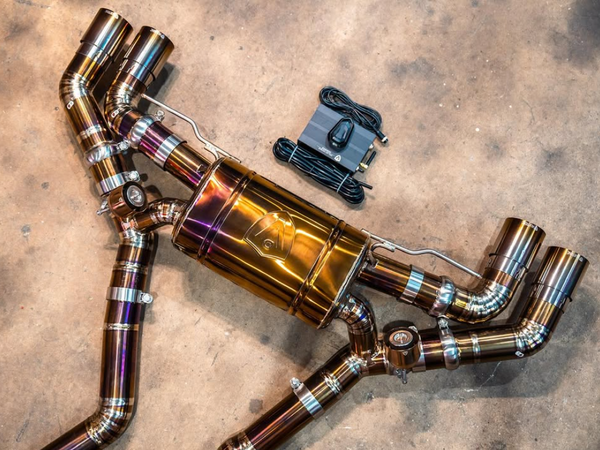
You want the best of both worlds. A valved system lets you open the valves for noise when you want it and close them for a quiet, drone-free cruise. It is the most effective single answer to drone on a street car, and the reason Armytrix, Valvetronic Designs, AWE Tuning and Akrapovič all build their flagship systems this way. If the technology is new to you, start with our explainer on what a valved exhaust actually is.
Choose a resonated system if
You prefer a fixed exhaust but still want civility. A system that keeps a resonator, or one specifically engineered to suppress drone, will be far more liveable than a straight-through design.
Ways to reduce drone
- Buy a valved exhaust: close the valves at cruise to silence the resonant frequency.
- Keep a resonator: resonators are specifically there to cancel problem frequencies.
- Keep the cat or a sports cat: removing the cat often increases drone and rasp.
- Choose a quality brand: reputable makers tune their systems to limit cabin resonance.
If you already have a droning exhaust, you are not entirely out of options. Adding a resonator to the system, fitting a helmholtz resonator tuned to the problem frequency, or refitting a sports cat can all help. These are fixes after the fact though, and they cost time and money you could have saved by choosing carefully in the first place.
A note on compliance in Australia
Drone is about comfort, but exhaust noise is also a legal matter, and the two are not the same thing. A system can be perfectly legal and still drone, or be quiet at the test and unpleasant at cruise. A valved exhaust helps on both counts, since running closed keeps you quieter around town as well as more comfortable. Our guide to Australian exhaust noise rules explains how testing works, and you should confirm the current limits with your state or territory roads authority before fitting a louder system. Do not treat a manufacturer's decibel claim as proof your setup is legal where you live.
Frequently asked questions
What causes exhaust drone?
Drone is a resonance that occurs when exhaust sound waves reinforce each other at a specific frequency, usually between 1,800 and 3,000 rpm where you cruise. It is caused by system design rather than outright volume.
How do I stop exhaust drone?
The most reliable fix is a valved exhaust, which lets you close the valves at cruising speed. Keeping a resonator or a catalytic converter in the system also helps, as does choosing a manufacturer that engineers against drone.
Do valved exhausts eliminate drone completely?
With the valves closed, a quality valved system is usually close to factory quiet at cruise, which removes the drone almost entirely. With the valves open you get the full volume, including any resonance that comes with it.
Can I fix drone on an exhaust I already own?
Often yes. Adding a resonator, fitting a helmholtz resonator tuned to the problem frequency, or refitting a sports cat can all reduce it. These are retrofits though, so choosing the right system first is cheaper.
The bottom line
Drone is the price people pay for not researching an exhaust before buying it, and it is almost entirely avoidable. It is a resonance at cruising rpm, not a function of outright volume, so the fix is choosing a system engineered to manage it. A valved exhaust is the most reliable answer because you can simply close the valves on the highway, and keeping a resonator or a cat helps too. Tell us your car and how you use it and we will recommend a system that sounds great when you want it and stays civil when you do not.
The Vero Motorsport Team
info@veromotorsport.com