Before we start: this article is general information only, not legal advice. We're exhaust specialists, not lawyers, and exhaust rules differ by state and change over time. Always confirm the current requirements with your state road authority or a licensed inspector before modifying your car.
"Is this exhaust legal?" is the single most common question we get, and the honest answer is: it depends on how it's built and how you use it. A valve-controlled exhaust can be one of the more compliance-friendly upgrades you can make - but only if you understand the rules it has to meet. Here's the plain-English version for Australian owners.
The two things that make an exhaust legal in Australia
Strip away the jargon and street-legal comes down to two tests. First, the exhaust must keep your car under its applicable noise limit. Second, it must retain the emissions equipment - principally the catalytic converters - that your car was built with. Pass both and a system can be legal for road use; fail either and you're exposed to a defect notice. Everything below is detail hanging off those two rules.
Noise limits and the ADR
Vehicle noise in Australia is governed at a national level by Australian Design Rule 83 (ADR 83), and then enforced by each state. The key concept is the stationary noise test: an inspector revs the engine to a set RPM and measures the sound level in decibels (dB(A)) from a fixed distance. Your car has a maximum it must not exceed.
As a general guide, many passenger vehicles built after 1983 are held to around 90 dB(A), and stationary caps in the 90-95 dB(A) range are common depending on the vehicle's build date and the state you're in. For vehicles with a compliance date after 1 September 2011 the reference is the ADR 83/00 standard; for older vehicles the limit is often the ADR signature level plus a small allowance. These are indicative figures - your exact limit depends on your specific vehicle and state, which is why a stationary test at an approved station is the definitive answer.
Catalytic converters and emissions
This is where a lot of enthusiasts come unstuck. If your car left the factory with catalytic converters, removing them (a "decat" or catless downpipe) breaches ADR and state vehicle standards and will trigger a defect if detected - regardless of how quiet the car is. A high-flow or "sports" catted downpipe that retains functioning cats is the compliant path if you want more flow; a catless one is not road legal. If downpipes are on your radar, our guides on catted vs catless downpipes and high-flow cat vs factory cat go deeper.
How enforcement actually works
Two things typically trigger scrutiny. Police can issue a defect notice roadside if they believe your exhaust is too loud or non-compliant, requiring you to have the car inspected and rectified before it's cleared. Separately, members of the public can report a noisy vehicle to the state EPA; in New South Wales, for example, that can lead to a vehicle inspection notice directing you to an approved station where noise is measured and pollution-control devices are checked. In short, you can be pulled up on the spot or reported after the fact - both roads lead to a stationary test.
How valve control helps with compliance
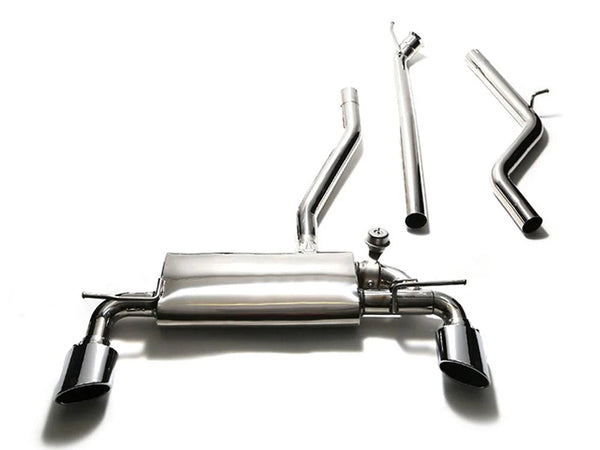
Here's the part that's genuinely useful for buyers. A valve-controlled exhaust has valves that open and close to change how freely the exhaust flows and how loud it is. With the valves closed, the system is much quieter - often close to factory volume. That gives you a real, physical way to keep noise down when it matters: during a stationary test, in a quiet residential street at night, or on a long cruise.
This doesn't magically make an illegal setup legal - if you've removed your cats, closing a valve won't save you, and a system that's over the limit even in quiet mode is still over the limit. But for a properly built valved cat-back that retains the cats, the ability to run quiet is a meaningful compliance advantage over a fixed loud exhaust that has one volume all the time. It's one of the strongest practical arguments for choosing a valved system in the first place. You can see the range in our Valvetronic Designs collection.
What is exhaust drone, and how does valve control fix it?
Drone is the low-frequency booming resonance you feel in the cabin at steady cruising speeds, usually somewhere between 2,000 and 3,500 rpm. It happens when sound waves inside the exhaust reflect back and reinforce each other, amplifying certain frequencies until they "boom" inside the car. It's most noticeable on the highway - not under acceleration - and it's the number one reason people regret a cheap, fixed aftermarket exhaust.
A valved exhaust is the most effective cure. Because the valves can be set to move toward the closed position in the exact RPM band where drone lives, a well-designed system lets you cruise without the headache and still open up when you want the noise. That behaviour can be tied to engine speed, throttle position or road speed. The result is a car that's civil on a five-hour drive and loud on demand - something a fixed exhaust simply can't do.
A sensible, compliant approach
If you want to stay on the right side of the rules: keep your catalytic converters, choose a quality valved cat-back that can run genuinely quiet with the valves closed, avoid catless downpipes for a street car, and be considerate about when you open the valves. That combination gives you the sound you want with the lowest compliance risk. For a broader overview of the rules, see our companion article, Are Aftermarket Exhausts Legal in Australia? Noise, Cats and Defects.
Frequently asked questions
Are valve-controlled exhausts legal in Australia?
A valve-controlled cat-back can be legal for road use if it retains your catalytic converters and stays under your state's stationary noise limit. The valve function helps you keep noise down for compliance. Removing cats or exceeding the noise limit is not legal. This is general information, not legal advice.
What is the exhaust noise limit in Australia?
It depends on your vehicle's build date and your state, but stationary limits around 90-95 dB(A) are common, with many post-1983 passenger cars held near 90 dB(A). An approved station running a stationary test is the only way to get your car's definitive figure.
Can I get defected for a loud exhaust?
Yes. Police can issue a defect notice roadside, and the EPA can direct you to an inspection after a public complaint. Both lead to a stationary noise test and a check of your pollution-control equipment.
Does closing the valves make any exhaust legal?
No. Closing the valves reduces noise, which helps a compliant system stay compliant, but it cannot fix an illegal setup such as removed catalytic converters or a system that exceeds the limit even in quiet mode.
The bottom line
Aftermarket exhausts can absolutely be legal in Australia - the key is keeping your emissions equipment and staying under your noise limit, and a valve-controlled system makes both easier while curing highway drone into the bargain. If you'd like help choosing a compliant valved exhaust for your car, browse the Valvetronic Designs collection or get in touch. Remember: confirm the current rules with your state authority before you modify - this article is general information, not legal advice.